





Introduction
A quiet but decisive shift is underway in aesthetic medicine. For two decades, the dominant paradigm was replacement — fill volume loss with injectables, erase wrinkles with neuromodulators, resurface damage with lasers. That paradigm is giving way to something different: regeneration. Rather than substituting what aging has taken away, regenerative aesthetics seeks to restore the skin’s own capacity to rebuild collagen, elastin, and extracellular matrix.
This is not a niche trend confined to academic dermatology. The global bio-stimulation therapies market grew from $2.05 billion in 2025 to $2.27 billion in 2026, at a compound annual growth rate of 10.8%, and is projected to reach $3.45 billion by 2030. Industry bodies including the AAFPRS have identified regenerative aesthetics and biostimulators as defining trends for 2026, noting that biostimulators like poly-L-lactic acid (Sculptra) and calcium hydroxyapatite are increasingly paired with energy-based modalities such as RF microneedling and ultrasound to stimulate collagen and elastin regeneration.
For clinic owners and aesthetic practitioners, the question is no longer whether to incorporate regenerative approaches, but how to build a treatment architecture in which biostimulators and energy-based devices work together rather than compete. This guide examines the biological rationale for combining these modalities, the clinical evidence supporting their synergy, and the equipment decisions that determine whether your clinic can deliver regenerative outcomes consistently.
Part 1: Why Regenerative Aesthetics Is Not Just Another Trend
The Paradigm Shift from Filling to Rebuilding
The most important conceptual change in aesthetic medicine is a shift in what clinicians are trying to achieve. As Australian plastic surgeon Dr. Niamh Corduff explains, regenerative aesthetics “focuses on improving the health, vitality and function of aging tissues, which in turn enhances appearance in a very natural way.” The driving insight is that aging is not solely about volume loss or sagging skin — it is about declining tissue quality.
This reframing has practical consequences. When the therapeutic goal is to restore tissue quality rather than to fill a void, the treatment sequence changes. Energy-based devices and biostimulators no longer occupy separate lanes of the treatment menu. They become sequential partners in a single biological process: create the conditions for repair, then supply the biological signals that direct it.
Dr. Corduff puts it plainly: “Regenerative approaches work alongside surgery, injectables and energy-based devices by improving the biological environment those treatments depend on.”
What Biostimulators Actually Do
Biostimulators are not fillers in the conventional sense. They do not simply occupy space. They initiate a biological cascade that leads to new collagen deposition over months.
Poly-L-lactic acid (PLLA, e.g., Sculptra) stimulates collagen types I and III through a mild inflammatory response. It is known for subtle, progressive volume enhancement, and also promotes angiogenesis and upregulates tropoelastin, contributing to smoother texture and improved skin tone.
Calcium hydroxyapatite (CaHA, e.g., Radiesse) works differently. Its microspheres provide both immediate structural support and collagen stimulation. CaHA makes direct contact with fibroblasts, causing mechanical activation of regenerative components. Microspheres degrade into calcium and phosphate ions, which are metabolized normally by the body.
The clinical implication is critical: biostimulators depend on a responsive biological environment. Fibroblasts must be present, active, and capable of synthesizing new matrix. This is precisely where energy-based devices enter the equation.
Part 2: The Biological Case for Combining Energy Devices with Biostimulators
Creating the Right Injury for the Right Repair
Energy-based devices — RF microneedling, fractional lasers, HIFU, and focused ultrasound — share a common mechanism: they create controlled micro-injury that triggers the body’s wound-healing cascade. This cascade proceeds through hemostasis, inflammation, proliferation, and remodeling. During the proliferative phase, fibroblasts switch phenotypes and actively deposit new matrix.
The timing of biostimulator introduction matters. When a biostimulator is introduced during the early proliferative phase — when fibroblasts are actively depositing matrix — it amplifies collagen and elastin synthesis. This is not simply additive; it is sequential synergy. The energy device creates the biological “window,” and the biostimulator supplies the building blocks and signals that direct the repair.
The Depth Complementarity Principle
The most persuasive argument for combination therapy is anatomical. Different energy modalities reach different tissue depths, and biostimulators act at a depth that no surface device can fully replicate.
RF microneedling delivers radiofrequency energy directly into the dermis at controlled depths — typically 0.5 mm to 3.5 mm depending on the device and needle configuration. This creates microscopic thermal zones that trigger collagen remodeling while sparing the epidermis. Perfectlaser’s Z709 RF microneedling system, for example, offers adjustable needle penetration from 0.2 mm to 7.0 mm, allowing practitioners to target precise dermal layers.
Fractional CO₂ lasers operate at 10,600 nm, a wavelength selectively absorbed by water. They create microthermal treatment zones (MTZs) that penetrate from the epidermis through the superficial to mid-dermis, inducing both ablative removal of damaged tissue and thermal stimulation of collagen remodeling in the surrounding dermis.
HIFU penetrates far deeper — to 4.5 mm for facial treatments, reaching the SMAS layer, and up to 13 mm for body applications. This is the depth at which structural lifting occurs.
Biostimulators, meanwhile, are injected into the dermis and subcutaneous layers, where they interact directly with fibroblasts and adipocytes. A systematic review of 29 studies found that treatments combining CaHA or PLLA with energy-based modalities including HIFU, fractional lasers, and microneedling demonstrated notable improvements in skin texture, elasticity, and contouring, particularly in areas with ageing signs.
The pattern is clear: RF microneedling and fractional CO₂ remodel the dermal matrix where biostimulators will later be active; HIFU lifts the structural foundation that biostimulators cannot reach; and biostimulators extend the biological effect of the energy treatment over months.
Part 3: Clinical Evidence and Treatment Sequencing
What the Evidence Shows
The clinical literature on combination therapy has grown rapidly. A 2025 systematic review published in Aesthetic Plastic Surgery examined combinations of biostimulators with botulinum toxin, dermal fillers, and energy-based devices across 29 studies. The conclusion was that combinations with energy-based modalities demonstrated notable improvements in skin texture, elasticity, and contouring. The review also highlighted an important limitation: current literature lacks a molecular understanding of the synergistic mechanisms, and standardized protocols are needed.
More recent research has begun to address the sequencing question directly. A multi-parametric biophysical analysis of energy-based devices and injectables proposed a 4-week sequential priming pathway that completely bypassed the acute barrier crisis seen in concurrent treatment pathways, achieving a significantly superior 12-week net elasticity endpoint. The finding supports a staged approach: energy treatment first to create the biological window, biostimulator second to amplify the repair response.
Practical Sequencing Protocols
Based on the available evidence and clinical consensus, the following sequencing principles have emerged:
For RF microneedling + biostimulator combinations: A commonly cited protocol involves spacing treatments four to six weeks apart. One clinic describes a protocol of two Sculptra sessions (two vials each) spaced several months apart, combined with three RF microneedling treatments one month apart. The RF sessions are performed first to condition the dermis, with biostimulator injections timed to coincide with the peak fibroblast activity window.
For fractional CO₂ + biostimulator combinations: Fractional CO₂ resurfacing creates a deeper wound bed and a longer healing cascade. Biostimulator introduction is typically deferred until re-epithelialization is complete and the proliferative phase is well established — usually two to four weeks post-resurfacing, depending on treatment depth and individual healing response.
For HIFU + biostimulator combinations: HIFU addresses the structural foundation at the SMAS level. A common approach is to perform HIFU first to establish the lifting framework, then introduce biostimulators to build dermal volume and quality within that framework. The two modalities address different anatomical problems and do not compete for the same tissue space.
A critical safety consideration: for RF microneedling with any injectables, clinicians generally wait at least one to two weeks after RF microneedling before performing cosmetic injections, including Sculptra. This interval allows the acute inflammatory response to resolve and reduces the risk of injecting into an actively inflamed tissue bed.
Part 4: The Equipment Portfolio That Makes Regenerative Aesthetics Possible
Why Device Choice Matters More Than Ever
In a monotherapy practice, a single device can carry a treatment category. In a regenerative practice, the equipment portfolio becomes the biological infrastructure that determines which combination protocols are feasible.
Three device categories form the backbone of a regenerative aesthetic portfolio:
1. RF Microneedling — The Dermal Conditioner
RF microneedling is the workhorse of regenerative combination therapy. It creates controlled dermal injury, stimulates fibroblast activity, and prepares the tissue bed for biostimulator introduction. Key specifications to evaluate include needle depth range, RF energy delivery precision, and epidermal sparing capability.
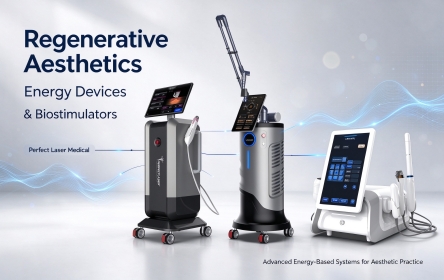
Perfectlaser’s Z709 RF Microneedling System is engineered for this role. It combines radiofrequency energy with adjustable needle penetration from 0.2 mm to 7.0 mm, allowing practitioners to target the precise dermal depth appropriate for each combination protocol. The system delivers fractional RF energy through insulated microneedles, creating thermal zones in the dermis while preserving the epidermal barrier — a critical advantage when the treatment plan includes subsequent biostimulator injection.
🔗 Z709 RF Microneedling System: https://www.perfectlasermed.com/product/perfectlaser-z709-professional-rf-microneedling-machine-3-in-1-skin-rejuvenation-system-for-wrinkles-scars-stretch-marks-z709/
2. Fractional CO₂ Laser — The Matrix Remodeler
Fractional CO₂ lasers address the more severe end of the regenerative spectrum: deep wrinkles, acne scars, surgical scars, and photoaged skin. The 10,600 nm wavelength creates controlled micro-injuries that stimulate collagen regeneration and improve skin elasticity. When sequenced before biostimulator treatment, fractional CO₂ establishes a remodeling environment in which biostimulator-driven neocollagenesis can proceed more effectively.
Perfectlaser’s Z131Pro CO₂ Fractional Laser is designed for precision resurfacing. Its SuperPulse mode achieves an optimal ablation-to-coagulation ratio, and its customizable parameters allow practitioners to modulate treatment depth and density according to the regenerative protocol being followed.
🔗 Z131Pro CO₂ Fractional Laser: https://www.perfectlasermed.com/product/perfectlaser-z131pro-co2-fractional-laser-machine/
3. HIFU — The Structural Foundation
HIFU operates at a depth that no other non-surgical device reaches. By delivering focused ultrasound energy to the SMAS layer at 4.5 mm, HIFU creates the structural lifting that provides a foundation for dermal regeneration. In a regenerative protocol, HIFU is typically the first treatment in the sequence — establishing the architectural framework within which subsequent dermal treatments and biostimulators will operate.
Perfectlaser’s HIFU systems offer multi-cartridge configurations for facial and body treatments, with depths ranging from 1.5 mm to 13 mm. This allows clinics to address both facial lifting and body contouring within a single regenerative treatment philosophy.
🔗 Z550A Multifunction HIFU: https://www.perfectlasermed.com/product/perfectlaser-hifu-machine-for-face-lifting-skin-tightening-z550a/
🔗 Explore Perfectlaser’s complete product portfolio: https://www.perfectlasermed.com/products/
The Integration Advantage
For distributors and clinic owners, the strategic value of a regenerative equipment portfolio extends beyond individual device performance. Devices that can be sequenced together — with compatible treatment depths, comparable recovery profiles, and coordinated timing protocols — allow clinics to offer regenerative programs rather than isolated treatments.
This shifts the commercial model from single-session transactions to multi-month treatment journeys. A patient entering a regenerative program typically undergoes HIFU for structural lifting, followed by RF microneedling to condition the dermis, followed by biostimulator injections to amplify collagen synthesis, with maintenance sessions over 12 to 18 months. The average transaction value and patient retention improve accordingly.
Part 5: What This Means for Clinics and Distributors
Building a Regenerative Service Menu
The transition from a device-centric to a regenerative service menu requires more than acquiring additional equipment. It requires a treatment architecture. The most successful regenerative practices structure their offerings around outcomes — “facial regeneration program,” “post-weight-loss skin restoration,” “acne scar resolution” — rather than around device names.
For clinics already offering RF microneedling or fractional CO₂, the incremental step is to establish referral pathways and sequencing protocols with biostimulator injectors. For clinics without energy-based devices, the entry point is often RF microneedling, given its versatility, safety profile across Fitzpatrick skin types, and compatibility with biostimulator protocols.
Equipment Selection Criteria for Regenerative Practice
When evaluating devices for a regenerative portfolio, five specifications deserve particular attention:
Adjustable depth range. The device must reach the dermal layers where biostimulators will act. RF microneedling systems with needle depth adjustability across at least 0.5 mm to 3.5 mm are well-suited; systems reaching 7.0 mm offer additional flexibility for body treatments.
Epidermal sparing capability. In protocols where biostimulators will be injected after energy treatment, preserving the epidermal barrier reduces infection risk and post-inflammatory hyperpigmentation risk. Insulated microneedle technology and fractional (rather than fully ablative) delivery are essential.
Parameter reproducibility. Regenerative protocols depend on consistency across sessions. Devices with programmable treatment settings and energy output verification allow clinicians to replicate the conditions that produced a successful outcome.
Cooling and comfort systems. Higher fluence and deeper needle penetration require proportionate cooling. Integrated contact cooling or cryogen systems enable the energy levels needed for meaningful dermal remodeling.
Compatibility with treatment sequencing. The device should be designed for use in multi-modality protocols. This means not only technical performance but also clinical documentation and training support for combination approaches.
The Distributor Opportunity
For distributors serving the aesthetic market, regenerative aesthetics represents a portfolio expansion opportunity with a distinctive commercial logic. Clinics adopting regenerative protocols need multiple device categories rather than a single flagship device. The distributor who can supply a coordinated portfolio — RF microneedling, fractional CO₂, HIFU, and supporting technologies — becomes a strategic partner rather than a transactional vendor.
Perfectlaser supports distributors with OEM and private-label services, comprehensive technical training, and clinical protocol documentation for combination therapies. Our devices are designed to function as integrated components of a regenerative treatment architecture, not as isolated standalone units.
📧 Contact for B2B partnership and distributor pricing: jessiexia@perfect-lasers.com.cn
🌐 Website: https://www.perfectlasermed.com
🔗 Product Catalog: https://www.perfectlasermed.com/products/
Summary: Key Takeaways
-
Regenerative aesthetics is a paradigm shift, not a trend. The market is growing at 10.8% annually, and industry bodies identify biostimulators as a defining trend for 2026. The shift is from filling volume loss to restoring tissue quality.
-
Biostimulators depend on a responsive biological environment. PLLA and CaHA initiate collagen synthesis, but their effectiveness depends on the presence of active fibroblasts and a healthy dermal matrix.
-
Energy-based devices create the biological window for biostimulator action. RF microneedling and fractional CO₂ create controlled micro-injury that triggers fibroblast activity; HIFU establishes structural lifting at the SMAS level. Biostimulators amplify and extend the repair response.
-
Sequencing matters. A 4-week sequential priming pathway has been shown to bypass the acute barrier crisis seen in concurrent treatment approaches, achieving superior elasticity endpoints. RF microneedling is typically performed first; biostimulators follow once the proliferative phase is established.
-
Device specifications determine feasibility. Adjustable needle depth (0.2–7.0 mm), epidermal sparing, and parameter reproducibility are the critical specifications for devices used in regenerative combination protocols.
-
A regenerative equipment portfolio is a commercial strategy. Clinics offering regenerative programs capture multi-month treatment journeys with higher transaction values and improved retention. Distributors who supply coordinated device portfolios become strategic partners.
-
Perfectlaser provides the equipment foundation. From the Z709 RF Microneedling System to the Z131Pro CO₂ Fractional Laser and HIFU platforms, our devices are engineered to function as integrated components of regenerative treatment architectures.
Disclaimer: This article is for educational and informational purposes only and does not constitute medical advice. Treatment decisions, including the sequencing of energy-based devices and injectable biostimulators, must be made by qualified medical professionals based on individual patient assessment and applicable regulations. Always follow the device manufacturer’s instructions and operate within your scope of practice.