





Skin laxity is not a surface problem. It is a structural failure that begins in the extracellular matrix and propagates upward through every supporting layer of the face and body.
Collagen provides tensile strength. Elastin provides recoil. The SMAS — the fibromuscular sheet beneath the dermis — provides the mechanical suspension that keeps tissue in position against gravity. When any one of these layers degrades faster than the body can repair it, the clinical result is sagging, folding, and loss of contour. Understanding which layer has failed is the prerequisite for choosing a treatment that actually addresses the mechanism — not just the visible symptom.
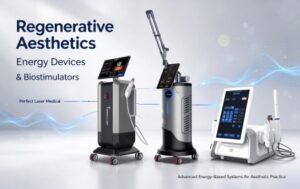
This article deconstructs the science of skin laxity layer by layer, and maps each mechanism onto the energy modality designed to intervene at that depth: fractional RF microneedling for dermal remodeling, and HIFU for SMAS-level contraction. The Perfectlaser Z709 and Z550A are built around this layered logic — not as competing alternatives, but as complementary instruments for different anatomical targets.
The Dermal Matrix: Collagen and Elastin as a Mechanical System
The dermis is a composite material. Type I collagen (approximately 80% of dermal collagen) provides stiffness and tensile strength. Type III collagen (roughly 15–20% in young skin) contributes to fine architecture and wound healing capacity. Elastin — a highly crosslinked, exceptionally durable protein — provides the elastic recoil that allows skin to stretch and snap back.
These are not independent variables. Collagen without elastin produces stiff but inelastic skin. Elastin without adequate collagen produces recoil without structural support. Skin tightness depends on both being present, organized, and mechanically coupled.
The aging trajectory of this system is measurable. Dermal collagen content declines by approximately 1% per year across adult life. The ratio of Type III to Type I collagen shifts from approximately 1:3 in young skin to 1:6 by age 50, reflecting a disproportionate loss of the more elastic, finer collagen architecture. Elastin degradation is driven substantially by UV-activated matrix metalloproteinases (MMPs) — particularly MMP-12 (macrophage metalloelastase) and MMP-7 — which cleave elastic fibers and disconnect the elastic network from cellular attachment sites. The consequence is not merely thinner skin, but mechanically incompetent skin: reduced tensile strength from collagen loss, and reduced recoil from elastin fragmentation.
This is the layer where fractional RF microneedling operates.
How RF Microneedling Rebuilds the Dermal Matrix
Radiofrequency microneedling creates controlled micro-injuries at adjustable depths and delivers bipolar RF energy directly into the dermis, bypassing the epidermis as the primary heat sink. The mechanism is dual: mechanical wounding triggers a wound-healing cascade, while RF-generated heat induces controlled collagen denaturation and subsequent neocollagenesis and neoelastogenesis. Histological studies confirm that RF microneedling increases proliferation of non-senescent fibroblasts and elevates both collagen and elastin levels in aged skin.
The clinical distinction from surface-level RF or laser resurfacing is depth precision. Dermal thickness and laxity severity vary across the face and body; a device that deposits energy at a fixed depth inevitably over-treats shallow zones and under-treats deep ones.
The Perfectlaser Z709 is engineered around this depth problem. It offers adjustable needle penetration from 0.2 mm to 7.0 mm — a range that spans superficial epidermal conditioning through deep dermal and upper subcutaneous remodeling. Three needle architectures allow the operator to match the thermal strategy to the target layer:
-
NV (Vacuum) heads with 29 mmHg suction lift the skin for uniform needle penetration and enhance RF coupling, while also extracting impurities from micro-channels.
-
IS (Insulated) heads confine RF energy to the needle tip, concentrating thermal effects at the target depth while sparing the epidermis — a design choice that reduces surface downtime and supports treatment of darker skin types.
-
IC (Exposed Tip) heads deliver energy along the exposed needle length, producing a broader zone of coagulation suitable for deeper remodeling and scar tissue.
The needles themselves are 0.2 mm ultra-fine, a specification that directly affects tolerability and recovery: smaller needle diameter reduces trauma to the epidermal punctum, supporting the “zero downtime” positioning of the platform. For conditions that sit on the same dermal ECM pathology — wrinkles, acne scars, stretch marks, and post-photoaging laxity — the Z709 provides the depth and energy control to treat the matrix rather than the surface.
But dermal remodeling alone does not address the deeper suspension problem. Collagen and elastin restoration improves skin quality and dermal thickness; it does not retension the fibromuscular sheet that has descended under gravity.
The SMAS: Why Deep Support Determines Visible Lift
Perfectlaser HIFU Machine for Face Lifting Skin Tightening Z550A
The superficial musculoaponeurotic system (SMAS) is a fibromuscular layer continuous with the platysma and facial mimetic musculature. It is the mechanical interface between the dermis and the deeper facial plane. When the SMAS loses tone or descends, the overlying skin and subcutaneous fat descend with it — regardless of how much collagen is restored in the dermis.
HIFU addresses this layer through focused acoustic energy. Unlike RF, which relies on needle insertion or surface coupling, HIFU concentrates ultrasound energy at a predetermined focal depth without injuring intervening tissue. At the focal zone, tissue temperature reaches 56–90°C (typically 60–65°C in collagen-rich targets), producing collagen denaturation, immediate contraction, and coagulative thermal injury zones, followed by delayed neocollagenesis and tissue remodeling. At 4.5 mm depth, HIFU can target the SMAS directly — the same anatomical plane addressed surgically in a facelift, but non-invasively.
This is a mechanically different effect from dermal RF. RF microneedling rebuilds the matrix. HIFU contracts and retensions the suspension layer. A treatment plan that uses only one modality is, by definition, addressing only one layer of a multi-layer problem.
The Perfectlaser Z550A is built to deliver this depth-targeted contraction across multiple anatomical planes. Its 12D HIFU platform offers 8 treatment cartridges spanning different skin depths, with over 20,500 shots per cartridge and one-shot 11-line emission for efficient large-area coverage. The depth range supports protocols from superficial dermal conditioning through 4.5 mm SMAS-level targeting — the layer most directly implicated in visible facial descent. The same platform extends beyond the face: Liposonix handpieces address subcutaneous fat for body contouring, and the VMAX handle provides fine-cartridge precision for periocular and small-area tightening.
For clinics, the practical value of the Z550A is not “more handpieces.” It is access to the depth layer that dermal-only devices cannot reach — the mechanical basis of lift, as distinct from the dermal basis of tightness.
Tightness vs. Lift: A Clinical Distinction That Determines Device Selection
Aesthetic medicine often conflates “tightening” and “lifting.” The science does not.
Tightening is a dermal phenomenon: increased collagen density, improved elastin organization, and reduced laxity at the tissue level. Lifting is a suspension phenomenon: repositioning or retensioning of the SMAS and its overlying soft-tissue envelope.
A patient with predominantly dermal laxity — thin, crepey skin with fine wrinkles and poor texture — will show limited response to SMAS-focused HIFU if the dermal matrix is not rebuilt. A patient with SMAS-level descent — midface ptosis, jawline blunting, nasolabial deepening — will show limited lift from dermal RF microneedling alone, because the suspension layer has not been addressed.
The Z709 and Z550A are not redundant products. They are layer-specific instruments. The Z709 rebuilds the dermal matrix at 0.2–7.0 mm with three needle strategies for different dermal targets. The Z550A delivers focused HIFU contraction at selected depths including the SMAS, with the cartridge range and shot volume to treat face and body in a single platform.
For distributors and clinic owners building a portfolio around skin laxity, this layered logic is also a commercial logic: a protocol that sequences dermal remodeling and SMAS retensioning addresses a broader patient population than either modality can serve alone. Patients present with mixed pathology — some collagen loss, some elastin fragmentation, some SMAS descent. A layered assessment supports a layered treatment plan, and a layered treatment plan supports higher-value protocols and stronger retention than a single-modality “tightening” offer.
The Bottom Line for B2B Buyers
Skin laxity is the visible endpoint of collagen depletion, elastin fragmentation, and SMAS descent. Each mechanism has a distinct anatomical address. RF microneedling intervenes in the dermal ECM to stimulate collagen and elastin remodeling. HIFU intervenes at the SMAS and deeper planes to contract and retension the suspension system.
The Perfectlaser Z709 brings adjustable-depth RF microneedling with vacuum-assisted, insulated, and exposed-tip needle strategies for dermal remodeling, scars, and stretch marks. The Z550A brings 12D HIFU with an 8-cartridge depth range and high shot volume for SMAS-level lift and multi-area body protocols.
The equipment decision is not “which technology is better.” It is which layers your patient population needs addressed, and whether your platform portfolio can reach them all. That is the question the Z709 and Z550A are designed to answer together.
FAQ
What causes skin laxity biologically?
Skin laxity results from collagen depletion (approximately 1% loss per year), elastin fragmentation driven by UV-activated MMPs, and descent of the SMAS fibromuscular layer. It is a multi-layer structural problem, not a surface-only condition.
What is the difference between HIFU and RF microneedling for skin tightening?
RF microneedling delivers energy through needles into the dermis to stimulate collagen and elastin remodeling. HIFU focuses ultrasound at predetermined depths, including the 4.5 mm SMAS, to contract and retension the deeper suspension layer. They address different anatomical targets.
Can the Perfectlaser Z709 treat stretch marks and acne scars?
The Z709 is positioned for wrinkles, skin laxity, acne scars, stretch marks, and texture irregularities through adjustable-depth fractional RF and microneedling-induced wound healing. Its 0.2–7.0 mm depth range and multiple needle types allow targeting of different scar and striae depths.
How deep can the Z550A HIFU reach, and what does that mean clinically?
The Z550A 12D HIFU platform offers 8 depth-specific cartridges, with capability extending to the 4.5 mm SMAS plane — the layer associated with visible lift rather than dermal-only tightening.
Request a Layered Laxity Protocol Briefing
Evaluating devices for a skin laxity protocol or distribution portfolio? Contact Perfectlaser to request a clinical briefing on the Z709 RF microneedling system and Z550A 12D HIFU platform — including depth-matching guidance, protocol sequencing recommendations, and distributor documentation.